Medical Research

The Butterfly Effect: Hashimoto's Treatment Breakthroughs

From selenium supplements to stem cell therapies, a new generation of treatments is transforming how we approach autoimmune thyroid disease.

Listen
Abstract illustration of butterfly emerging from thyroid-shaped cocoon with pharmaceutical molecular structures
01

Selenium Finally Gets Its Due: Major Meta-Analysis Confirms Antibody Reduction

For years, selenium supplementation lived in a gray zone between "promising" and "prove it." That era is over. A comprehensive systematic review and network meta-analysis has confirmed what many functional medicine practitioners suspected: selenium significantly reduces both TPOAb and TgAb levels in Hashimoto's patients.

The data is unambiguous. Patients showed measurable antibody reduction regardless of whether they were already on levothyroxine replacement. Even more compelling: the analysis highlighted selenium's role in reducing oxidative stress markers, specifically malondialdehyde. This suggests we're not just masking symptoms but addressing underlying inflammatory mechanisms.

The clinical implication: Selenium supplementation has graduated from "experimental" to "evidence-based" for antibody reduction. If your endocrinologist hasn't discussed it, bring it up.

The standard dosage in these studies: 200mcg daily. But here's the critical nuance most coverage misses: selenium has a narrow therapeutic window. More is not better. Toxicity symptoms can emerge at doses only 2-3x the beneficial amount. This is precisely why medical supervision matters.
02

Weekly Shots Instead of Daily Pills: The Absorption Problem Gets a Real Solution

Ask any Hashimoto's patient about their morning routine and you'll hear the same frustration: take levothyroxine on an empty stomach, wait 30-60 minutes before eating or coffee, pray your gut is cooperating today. Variable absorption has been the Achilles heel of thyroid hormone replacement for decades.

Phase II trials are now underway for once-weekly levothyroxine injections that bypass the entire gastrointestinal drama. The implications are enormous for the subset of patients who do everything right but still experience fluctuating TSH levels due to absorption issues, whether from celiac disease, inflammatory bowel conditions, or the dozen medications that interfere with thyroid hormone uptake.

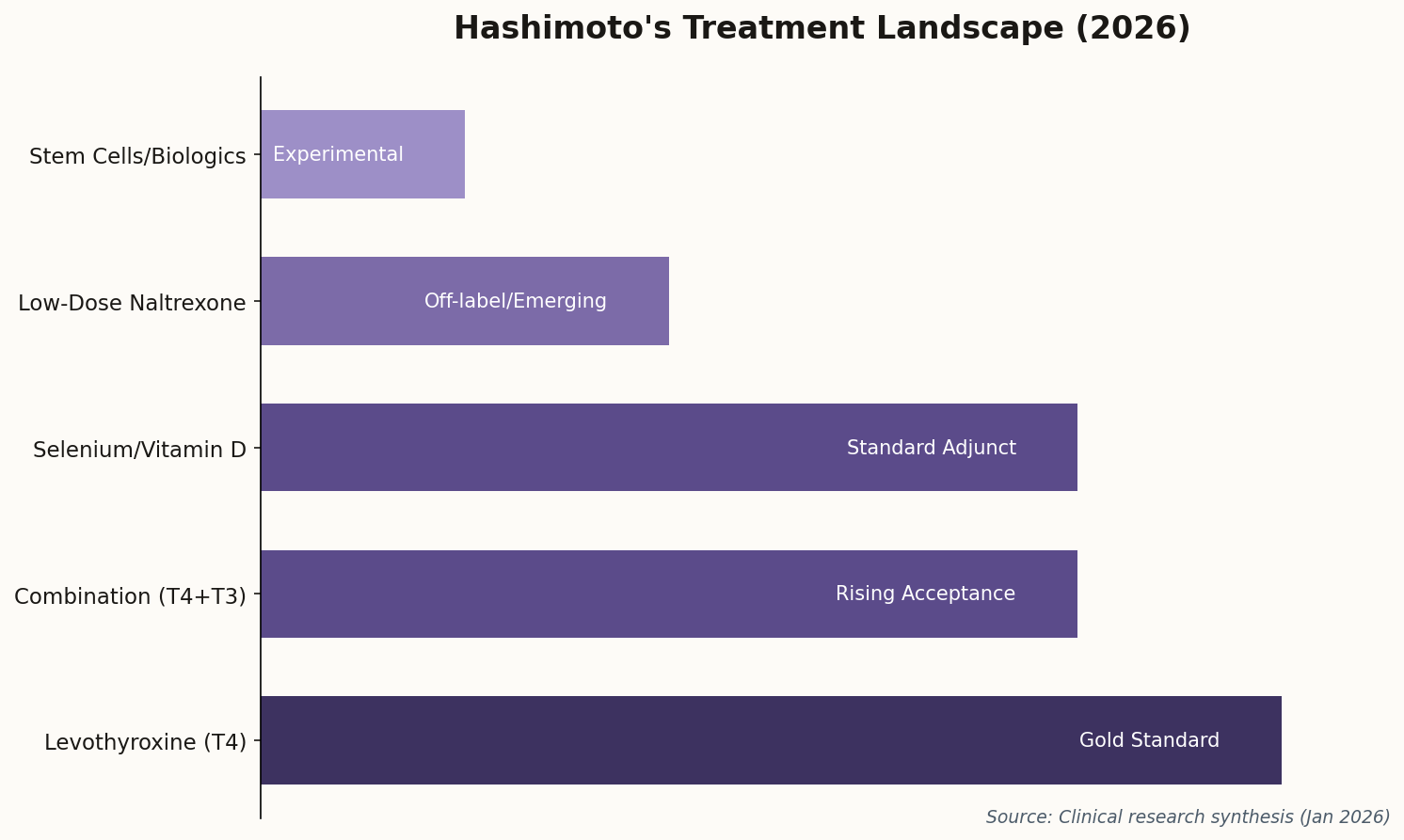
Bar chart showing Hashimoto's treatment landscape with clinical adoption levels
Current treatment options range from gold-standard levothyroxine to experimental stem cell therapies, with several emerging approaches gaining clinical traction.

Meanwhile, liquid and gel-cap formulations like Tirosint and Adthyza are becoming preferred options for sensitive patients. These newer formulations minimize excipients—the dyes, gluten, and fillers that cause reactions in a significant minority of patients.

The trend is clear: the era of one-size-fits-all T4 replacement is ending. Precision delivery is becoming the standard.

03

Stem Cells Target the STING Pathway: The Molecular Roadmap to Regeneration

Stem cell therapy for autoimmune conditions has long promised more than it delivered. The appeal is obvious: instead of suppressing the immune system or replacing hormones indefinitely, why not regenerate damaged tissue and recalibrate immune function? The problem was always mechanism—we knew MSCs (mesenchymal stem cells) helped, but not precisely how.

New research has identified the STING pathway as a key target for MSCs in alleviating autoimmune thyroiditis. The cells modulate macrophage phenotypes, shifting the immune landscape from pro-inflammatory M1 to anti-inflammatory M2 states. This isn't just symptom suppression—it's addressing the immune dysregulation at its source.

Perhaps most exciting: the studies demonstrated potential for structural regeneration of thyroid tissue, not just immune modulation. For patients who've lost significant thyroid function, this represents something hormone replacement can never offer—the possibility of restored native function.

Reality check: These are pre-clinical findings. FDA-approved stem cell trials for Hashimoto's remain years away. But this molecular roadmap is precisely what regulatory bodies need to see before approving human trials. The path from "theoretical" to "treatable" just got shorter.

04

Metformin Without Diabetes: Drug Repurposing Finds an Unlikely Thyroid Ally

The most exciting drug for Hashimoto's might already be in millions of medicine cabinets—just prescribed for a different condition. The METHAP trial interim results show metformin reducing both TSH levels and thyroid antibodies in non-diabetic Hashimoto's patients.

The mechanism is elegant: metformin appears to balance Th17/Treg cell dynamics and inhibit germinal center formation—the immune system machinery that produces the autoantibodies attacking your thyroid. In other words, it's not just lowering blood sugar; it's recalibrating immune function.

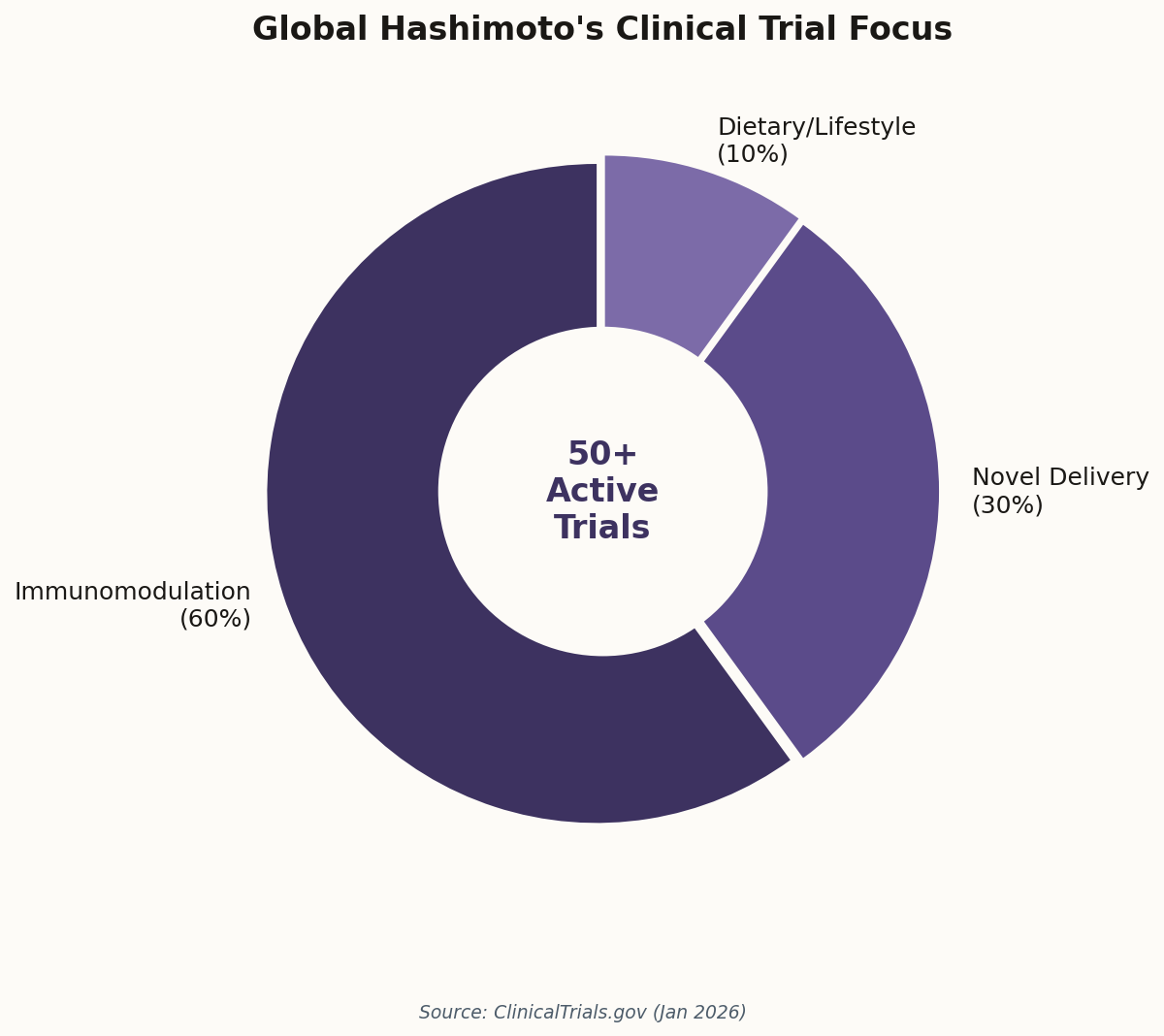
Donut chart showing clinical trial focus areas for Hashimoto's treatments
Over 50 active interventional studies are investigating Hashimoto's treatments globally, with immunomodulation leading research focus.

The practical implications are significant. Metformin is:

  • Cheap (generic for decades)
  • Well-understood (billions of patient-years of safety data)
  • Widely available (any physician can prescribe it)

For patients who don't respond adequately to hormone replacement alone, this offers a pragmatic option that doesn't require waiting for novel drug approvals or specialized treatment centers.

05

The TRIUMPH Trial: Finally Taking Fatigue Seriously

"Your labs are normal." If you have Hashimoto's, you've probably heard this while feeling anything but normal. The TRIUMPH trial represents a paradigm shift: it's investigating mycophenolate mofetil specifically for persistent fatigue in women with normal thyroid function but elevated antibodies.

This matters because it acknowledges what patients have known for years: TSH normalization doesn't equal wellness. The autoimmune process itself—the inflammation, the antibody activity—produces symptoms independent of hormone levels. Until now, the medical establishment largely dismissed these complaints as unrelated to thyroid disease.

Charts showing Hashimoto's demographics including gender distribution and age at diagnosis
Hashimoto's predominantly affects women (7:1 ratio) with peak diagnosis occurring between ages 30-50.

The trial's focus on mycophenolate—an immunosuppressant typically used in transplant patients—signals how seriously researchers are taking the immune component. If successful, it could establish a new treatment category: immunomodulation for quality of life, not just hormone replacement for lab values.

Recruitment is ongoing. For eligible patients in the UK, this is an opportunity to contribute to research that could redefine how Hashimoto's is treated.

06

Red Light Therapy Moves From Fringe to Evidence Base

Photobiomodulation—applying specific wavelengths of red and near-infrared light to tissue—has long occupied the awkward space between "biohacker enthusiasm" and "show me the data." That's changing. Review of 2024-2025 findings presented at the European Congress of Endocrinology showed significant improvements in TSH and anti-TPO levels when red light therapy was combined with conventional treatment.

The proposed mechanisms include reduced oxidative stress, improved mitochondrial function, and modulation of local inflammation. The thyroid, sitting just below the skin surface of the neck, is particularly accessible to light-based therapies.

What makes this noteworthy isn't just the efficacy signal—it's the accessibility. Unlike stem cells or novel biologics, photobiomodulation devices are:

  • Available without prescription
  • One-time purchase (no recurring costs)
  • Home-usable with minimal training
  • Non-pharmaceutical (no drug interactions)

The evidence isn't yet strong enough to recommend it as monotherapy, but as an adjunct to standard care? The risk-benefit calculation is becoming favorable. Watch this space.

The Transformation Continues

What strikes me most about this research landscape isn't any single breakthrough—it's the shift in philosophy. We're moving from "replace what's broken" to "understand why it broke." From "normalize your labs" to "restore your quality of life." From one-size-fits-all to precision medicine. The butterfly is emerging from its cocoon. The next few years will be interesting.