
Market Outlook

The Bull Case

Wall Street is unanimous: 2026 will be another up year. But with valuations at dot-com levels and the Magnificent 7 stumbling out of the gate, the question isn't whether to be bullish—it's whether the bulls are right.

Listen
Abstract financial visualization with golden upward trending lines against navy blue
01

The Magnificent 7 Stumble Out of the Gate

Two weeks into 2026, and the market's engine is sputtering. Five of the seven mega-cap tech stocks that drove the S&P 500's rally are now in the red: Nvidia, Apple, Microsoft, Meta, and Tesla have all slipped. Only Alphabet and Amazon are bucking the trend.

The Magnificent 7's collective momentum appears to be fading, and the elite group is now acting as a drag on the broader market rather than its engine. Profits for the group are expected to climb about 18% in 2026—the slowest pace since 2022 and not much better than the 13% rise projected for the other 493 companies in the S&P 500. The "earnings exceptionalism" that justified premium valuations is converging toward the mean.

Former Cisco CEO John Chambers believes 2026 will be a year of divergence within the group. Wall Street's favorite for the year? Nvidia. The least loved? Tesla and Apple—the former facing stagnant revenue growth, the latter lacking visible AI leadership despite trading at 31x earnings.

The hierarchy shift: Wall Street projects big gains for Amazon, Meta, and Microsoft. Apple attracted pessimism from business leaders who pointed to departing executives and a mature product line. One AI founder said of Nvidia CEO Jensen Huang: "I'd rather be in Jensen's seat than anywhere else."
02

2026: The Year of the Bubble?

Contrarian voices are growing louder. A Motley Fool analysis identifies up to four bubbles at risk of bursting in 2026, leading one analyst to declare this may be "the Year of the Bubble" on Wall Street.

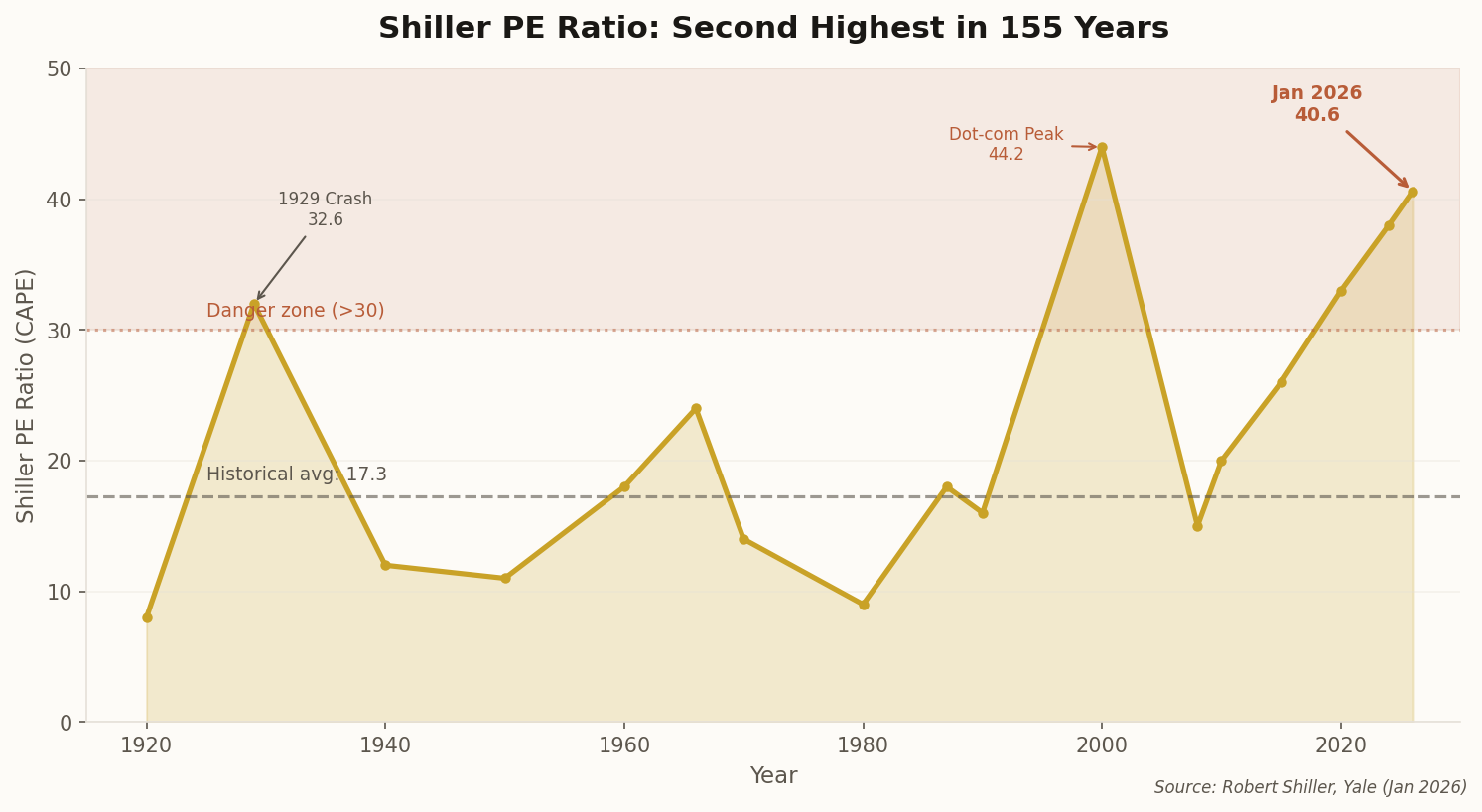
The math is uncomfortable. Warren Buffett's favorite valuation metric—total market cap divided by GDP—sits near 225%. Anything over 160% is considered significantly overvalued. The last time it approached 200%? The year 2000, right before the tech crash. The Shiller PE ratio has only exceeded 40 once in 155 years of market history—during the months before the dot-com bubble burst.

Many technical analysts are forecasting an intra-year correction of 10% to 20%, which would see the S&P 500 pull back from current levels near 6,900 toward 5,600–6,000. That's not a crash prediction—it's a reversion to historical norms. The question is whether investors have the stomach for a 15% drawdown after three straight years of gains.

The counterargument: Valuation metrics like CAPE examine past earnings, not future potential. On a forward P/E basis, Nvidia trades at just 25x, while Alphabet, Amazon, and Microsoft all trade below 30x while growing revenue quickly. As Nobel laureate Robert Shiller himself notes, "The CAPE ratio is a red flag when it exceeds 30"—not a guarantee of imminent collapse.

03

The Shiller PE Hits Dot-Com Territory

As of January 6, the Cyclically Adjusted Price-to-Earnings ratio—better known as the Shiller PE—hit 40.58. That's the second-highest reading in 155 years of market history, exceeded only by the 44.19 peak in December 1999, months before the dot-com crash.

Line chart showing Shiller PE ratio from 1920-2026, with current reading of 40.6 marked as second highest ever
The Shiller PE ratio has only exceeded 40 once before—during the dot-com bubble. Source: Robert Shiller, Yale (Jan 2026)

The historical mean is 17.3. Today's market trades at a 135% premium to that average. Every time the ratio has sustained above 30, the market has eventually seen a 20%+ decline. During the dot-com normalization, the S&P 500 dropped nearly 50% and delivered a "lost decade" of returns.

The Fed finds itself in a difficult position. Any hawkish tilt to combat lingering inflation could trigger a valuation collapse, while continued accommodation might further fuel an unsustainable bubble. With Chair Jay Powell's term expiring in May 2026, uncertainty about his successor adds another variable to an already unstable equation.

The historical pattern: High starting valuations almost always correlate with lower 10-year forward returns. The mathematical reality remains: buying expensive usually means earning less. Whether 2026's companies justify their prices better than 1999's pets.com remains the central question.

04

21 Analysts, Zero Bears: Wall Street's Unanimous Bull Call

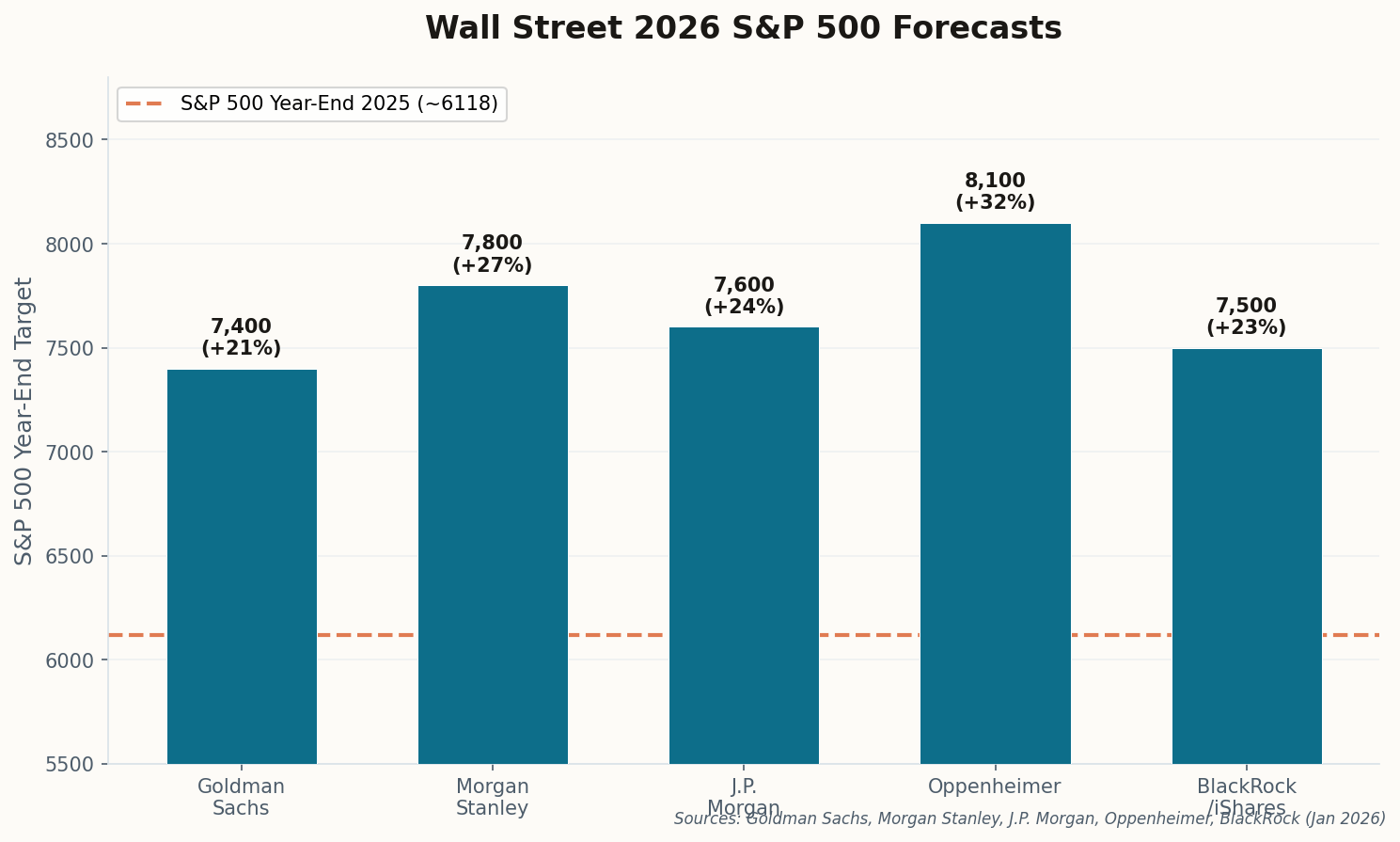
Here's a statistic that should give you pause: of the 21 Wall Street strategists surveyed by Bloomberg News, not a single one predicts a down year for 2026. The last time the market delivered four consecutive up years was the late 1990s—which ended poorly.

Bar chart showing Wall Street S&P 500 targets ranging from 7,100 to 8,000
Every major Wall Street firm predicts the S&P 500 will rise in 2026. Targets range from +3.7% (BofA) to +16.9% (Deutsche Bank). Source: Goldman Sachs, Morgan Stanley, JPMorgan, BofA, Deutsche Bank (Jan 2026)

Goldman Sachs targets 7,600 (+11%), with strategists projecting 12% EPS growth and identifying five key themes: accelerating GDP growth, corporate re-leveraging, AI adoption, a rise in IPOs and dealmaking, and value stock rotation. Morgan Stanley is the most bullish at 7,800 (+14%), while Bank of America anchors the low end at 7,100 (+3.7%).

The consensus driver: earnings. Wall Street forecasts S&P 500 EPS of roughly $306 in 2026, up 12.5% from 2025's $272 estimate. Big tech remains the profit engine—BlackRock says AI will "keep trumping tariffs and traditional macro drivers." But that unanimity itself is a warning sign. Markets rarely deliver what everyone expects.

The meta-lesson from 2025: Any advantage for an AI lab was temporary. Once one lab proved a capability, others quickly followed. Wall Street expects this "fast-follower" dynamic to persist—meaning no one stays ahead for long, and margins face constant pressure.

05

The Fed's Balancing Act: Two Cuts, Many Risks

The Federal Reserve has cut rates six times since September 2024, bringing the overnight rate to 3.50%–3.75%. Most FOMC members expect at least one more cut in 2026, with the CME Group's FedWatch tool pointing to two—likely in April and September.

Goldman Sachs and BofA analysts anticipate two quarter-point reductions, targeting a terminal rate of 3.00%–3.25%. The theory: falling rates reduce the cost of debt, boost corporate profits, and allow companies to borrow more for growth. Soft-landing cuts have historically been positive for stocks.

But there's a catch. Although lower rates would theoretically benefit equities, they can have the opposite effect if investors fear recession. The January CPI print gave Wall Street some good news, but not enough to move the Fed's January timeline—95% certainty the rate holds steady this month. And in a downside scenario, the Fed could cut 200–300 basis points if the economy slows sharply.

The tariff drag: Trump's tariffs raised the average tax on imports to 16.8%—the highest since 1935. Goldman estimates 67% of the burden will fall on consumers by mid-2026. The resulting inflation pressure complicates the Fed's path toward further cuts.

The Uncomfortable Math

Wall Street's unanimous optimism rests on a simple thesis: AI-driven earnings growth will justify current valuations. But history offers a sobering counterpoint. The Shiller PE has only been this high once before, and what followed was a 50% crash and a lost decade. The Magnificent 7's growth is decelerating. The Fed's room to cut is constrained by tariff-driven inflation. The bull case isn't wrong—it's just priced in. For 2026, the question isn't whether to invest, but whether to expect the returns the market has already promised itself.