Cognitive Science

The Atrophy Trade-Off

AI makes you faster. It might also make you dumber. A year of research is reaching the same uncomfortable conclusion: the productivity gains come with a cognitive tax we're only beginning to measure.

Listen
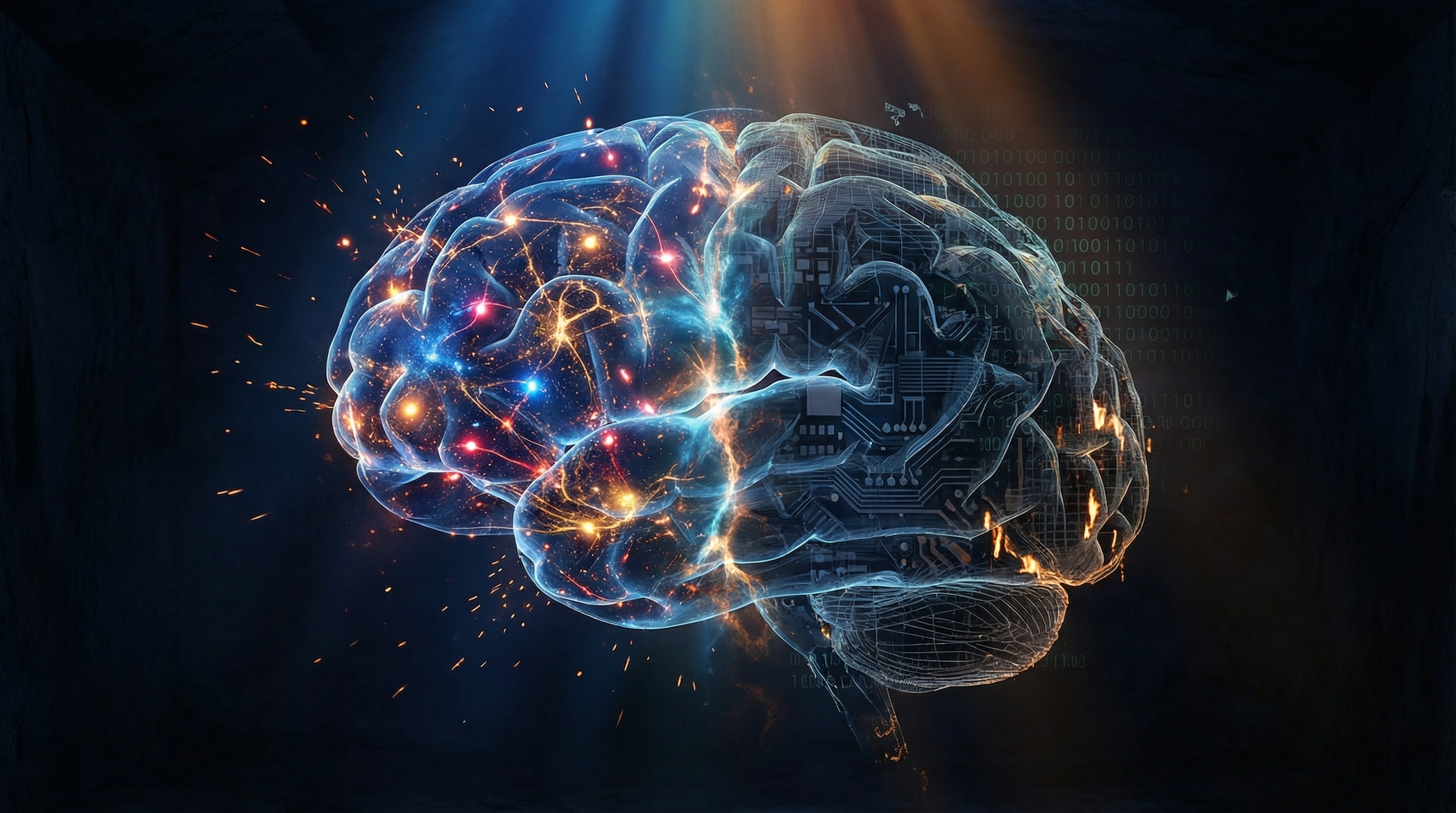
Abstract visualization of brain hemispheres in tension between human cognition and AI dependence
01

Harvard's Verdict: "If AI Does Your Thinking, You're Not Thinking"

The Harvard Gazette assembled six faculty experts to assess AI's cognitive impact. Their consensus is blunt: we're trading thinking for convenience, and the exchange rate is worse than we assumed.

Christopher Dede, Senior Research Fellow at Harvard's Graduate School of Education, frames the ideal as "AI like an owl on your shoulder"—augmenting rather than replacing cognition. But he warns against letting AI "do your thinking for you, whether through auto-complete or 'let AI write the first draft.'" That approach, he says, "undercuts your critical thinking and your creativity."

Dan Levy of the Kennedy School puts it even more plainly: "No learning occurs unless the brain is actively engaged." The essay you outsourced isn't just a shortcut—it's a skipped workout for your mind. Meanwhile, Karen Thornber compares AI dependence to GPS navigation eroding our mental maps. Convenient? Absolutely. But what happens when the signal drops?

The distinction that matters: Using AI as a "crutch" versus a "learning tool" produces opposite outcomes. The technology is neutral. How you deploy it determines whether you're building capability or outsourcing it.

02

MIT's Brain Scans Show ChatGPT Users Have the Least Cognitive Engagement

The MIT Media Lab went beyond surveys and measured what happens inside the brain. Their study divided 54 students into three groups: ChatGPT-only, Google-assisted, and unassisted. They monitored neural activity via EEG while participants wrote essays over four months.

The results weren't subtle. The ChatGPT group showed the lowest brainwave activity and measurable cognitive decline in focus, memory, and attention networks. The kicker: 83% of AI-dependent participants couldn't recall key points from their own essays. None could provide accurate quotes from papers they had "written."

Even more troubling: the cognitive impairment persisted after participants stopped using AI. The researchers found that early reliance on AI "impairs memory, meaning-making, and idea synthesis"—the very foundations of critical thinking.

The timing insight: MIT found that using AI after the brain has deeply engaged with material may actually support cognition. But reaching for ChatGPT first? That's when the damage occurs. The brain gets lazy before it has a chance to work.

03

Wharton Finds AI Boosts Quality but Kills Diversity: Only 6% of Ideas Were Unique

Wharton professors Gideon Nave and Christian Terwiesch, along with Mack Institute fellow Lennart Meincke, published research in Nature quantifying what many suspected: AI-generated ideas converge toward sameness.

The numbers are stark. Only 6% of AI-generated ideas were considered unique, compared to 100% in human-only groups. In 37 out of 45 comparisons, ChatGPT-assisted ideas showed significantly less diversity. "The ideas are great," Terwiesch notes, "but not as diverse as human-generated ideas. That points to a trade-off to be aware of."

The mechanism is straightforward: "When you give the model the same prompt, it tries to average the most likely completions," explains Meincke. What emerges is polished, plausible—and predictable. The researchers recommend deliberately varying prompts, starting with human ideas first, and testing multiple models simultaneously to break the homogeneity trap.

04

Microsoft's 319-Worker Study: Higher AI Confidence Means Less Critical Thinking

Microsoft Research surveyed 319 professionals across occupations, collecting 936 real-world AI use cases and analyzing how AI affected their critical thinking. The pattern they found cuts against the "AI as thought partner" narrative.

Workers who trusted AI more applied less critical thinking. Those confident in their own abilities engaged more deeply—but reported higher cognitive costs. The study found that critical thinking shifted from generating ideas to "information verification, response integration, and task stewardship." In other words: instead of thinking, we're now fact-checking AI's thinking.

The barriers to deeper engagement? Lack of awareness that critical thinking was even needed, time pressure reducing motivation, and difficulty refining prompts. The researchers, led by Sean Rintel and Leon Reicherts, found that high-stakes tasks triggered more careful scrutiny—but routine tasks under deadline? That's where thinking gets outsourced.

05

666 Participants, One Finding: AI Offloads Cognition and Weakens Critical Thinking

Researcher Michael Gerlich's study, published in the journal Societies, examined 666 participants across ages and educational backgrounds. The findings were unambiguous: frequent AI tool usage correlated negatively with critical thinking abilities, mediated by cognitive offloading.

"The key takeaway is that while AI tools can enhance productivity and information accessibility, their overuse may lead to unintended cognitive consequences," Gerlich told PsyPost. "Reliance on AI tools could reduce opportunities for deep, reflective thinking."

A generational divide emerged: younger participants showed higher AI dependence and lower critical thinking scores than older counterparts. The study introduces "AICICA"—AI Chatbot-Induced Cognitive Atrophy—to describe the deterioration of critical thinking, analytical acumen, and creativity from over-reliance on AI assistants. It's not just a concern. It has a name now.

The "use it or lose it" principle: Humans lose capabilities they don't exercise. We lose muscle mass without physical activity, spelling ability when autocorrect handles it, mental math when calculators are always present. AI-assisted cognition appears to follow the same rule.

The Uncomfortable Question

If AI makes work 20% more productive but 20% less meaningful—what's the net benefit? The research increasingly suggests we're not just outsourcing tasks but outsourcing the development of capability itself. The workers who extract the most value from AI are those with deep expertise: they ask better questions and recognize weak answers. They earned that discernment the hard way. The question for everyone else: if you skip the struggle that builds judgment, will you have judgment when you need it?